
kuz.

episode · perception

Have you ever actually been still?

You spin, orbit, and tear through the galaxy at over 2 million km/h. You feel none of it.

Thumbnail for Have you ever actually been still?

The 50-word answer

No, and you never will be. Sit perfectly still and you are still spinning with the Earth at over 1,600 km/h at the equator, falling around the sun at about 107,000 km/h, being dragged around the galaxy at over 800,000 km/h, and tearing through the universe at more than 2 million km/h relative to the leftover light of the Big Bang. You feel none of it because steady velocity exerts no force your body can sense. You have been moving from your first second to your last.

Transcript

Right now, try to sit perfectly still. As still as you possibly can. You feel motionless. You are not.

The ground under you is spinning. At the equator, the Earth turns at over sixteen hundred kilometres an hour.

And that whole spinning planet is falling around the sun, at a hundred and seven thousand kilometres an hour.

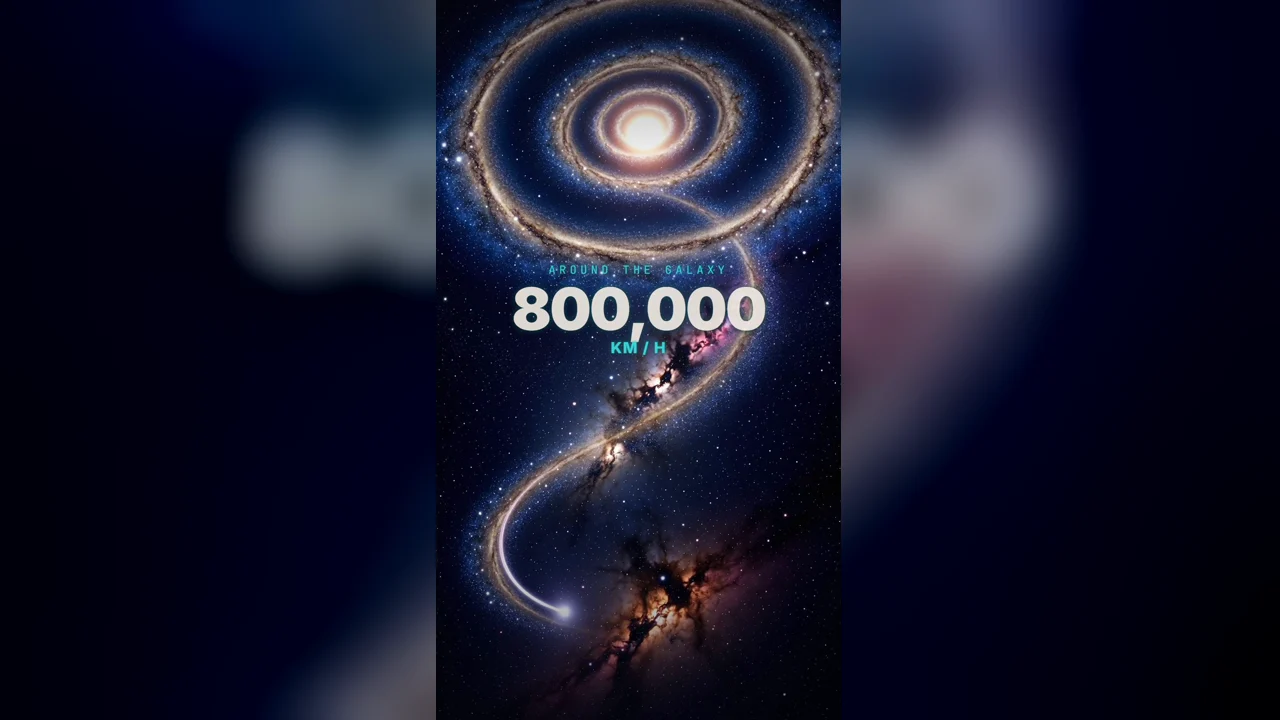
The sun is dragging you around the galaxy at over eight hundred thousand.

And the entire galaxy is tearing through the universe at more than two million kilometres an hour.

You feel none of it.

You have never been still. Not once. Not in your deepest sleep. Not in the womb.

From your first second to your last, you have been screaming through space.

And you will not stop, until the day you finally do.

Sources

  1. NASA Goddard Institute for Space Studies / NASA Science, "Earth Fact Sheet" (David R. Williams, NASA NSSDCA). Earth's equatorial circumference is 40,075 km and one sidereal rotation takes about 23.93 hours, giving an equatorial surface speed of roughly 1,670 km/h. The figure quoted as "over 1,600 km/h" is the eastward spin you carry at the equator. Open source
  2. NASA NSSDCA "Earth Fact Sheet" (orbital parameters). Earth's mean orbital velocity around the Sun is 29.78 km/s, which is about 107,000 km/h. This is the speed at which the whole planet, and you on it, falls around the Sun. Open source
  3. Reid, M. J., et al. (2014). "Trigonometric Parallaxes of High Mass Star Forming Regions: The Structure and Kinematics of the Milky Way." The Astrophysical Journal, 783(2), 130. DOI: 10.1088/0004-637X/783/2/130. VLBI maser parallaxes place the Sun roughly 8.3 kpc from the Galactic centre orbiting at about 240 km/s, i.e. over 800,000 km/h, the speed the Sun drags the solar system around the galaxy. Open source
  4. Planck Collaboration (2020). "Planck 2018 results. I. Overview, and the cosmological legacy of Planck." Astronomy & Astrophysics, 641, A1. DOI: 10.1051/0004-6361/201833880. The cosmic microwave background dipole corresponds to a Solar System motion of 369.82 km/s relative to the CMB rest frame; the Local Group moves at about 620-630 km/s, i.e. more than 2 million km/h, relative to the leftover light of the Big Bang. Open source
  5. Kogut, A., et al. (1993). "Dipole Anisotropy in the COBE Differential Microwave Radiometers First-Year Sky Maps." The Astrophysical Journal, 419, 1. DOI: 10.1086/173453. The original precise CMB dipole measurement (371 km/s for the Solar System; about 627 km/s for the Local Group), the foundational evidence that we are moving at over two million km/h through the universe even when we feel motionless. Open source

related

other things you've googled.

follow kuz for the next answer.

Follow kuz on YouTube